Our Training Programs

Training programs designed to strengthen your skills in quality, compliance, and accreditation.

5 training(s) available

Determination of measurement uncertainty in physical chemistry: principles, methods, and applications
3 days 150 000

Determination of measurement uncertainty in physical chemistry: principles, methods, and applications

Managing measurement uncertainty is essential for ensuring the reliability and comparability of physicochemical analysis results. In testing laboratories, assessing uncertainty makes it possible to identify the main sources of uncertainty, quantify their contribution, and express results reliably. This competence is particularly important when implementing ISO/IEC 17025 requirements, validating methods, and interpreting analytical results. Upon completion of the training, you will be able to determine an appropriate measurement uncertainty. Targeted skills: - explain the fundamental concepts related to measurement uncertainty, - identify the various sources of uncertainty associated with a measurement process, - utilize data on repeatability, reproducibility, calibration, and equipment resolution to estimate uncertainty using various approaches, - evaluate the uncertainty associated with different physicochemical analysis methods, - prepare an uncertainty budget to determine the expanded uncertainty of the result.
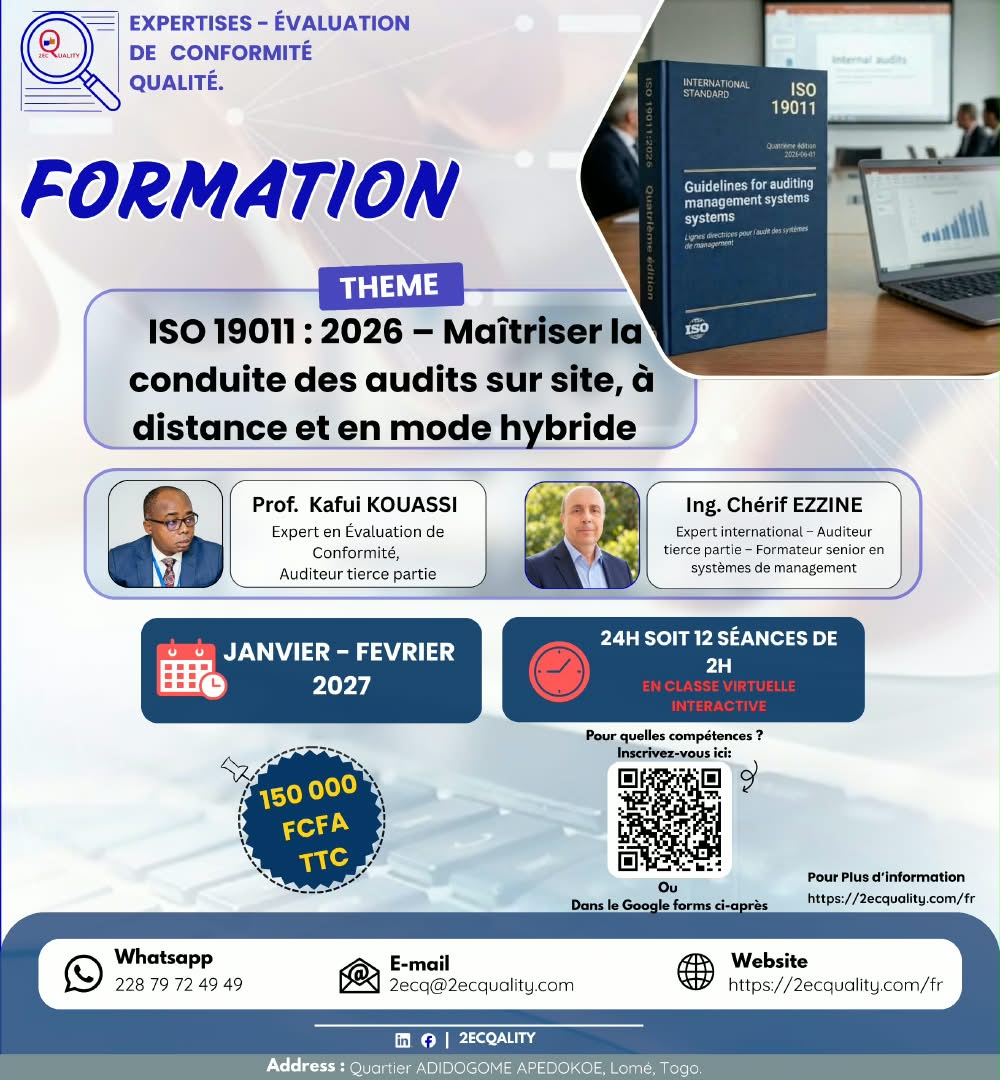
ISO 19011:2026 – Mastering the conduct of on-site, remote, and hybrid audits.
3 (12 sessions of 2 hours) 150 000

ISO 19011:2026 – Mastering the conduct of on-site, remote, and hybrid audits.

Management system auditing is an essential tool for evaluating the conformity, effectiveness, and capability of a management system to achieve expected results. The publication of ISO 19011:2026 updates the guidelines regarding audit principles, the management of audit programs, the conduct of audits, and the assessment of auditor competence. It also addresses remote auditing methods and virtual environments in order to adapt audit practices to new ways of working. Overall objective: To be able to apply audit principles, methods, and techniques in accordance with ISO 19011:2026, adopting an evidence- and risk-based approach. Targeted skills: - Interpret fundamental principles and new terminology related to auditing, - Implement an audit program aligned with management directives, - Prepare the documented information required for effective audit execution, - Conduct a pre-audit document review (on-site or online), - Apply audit methods and techniques (on-site and online), - Evaluate the audit evidence gathered, - Formulate factual audit findings.

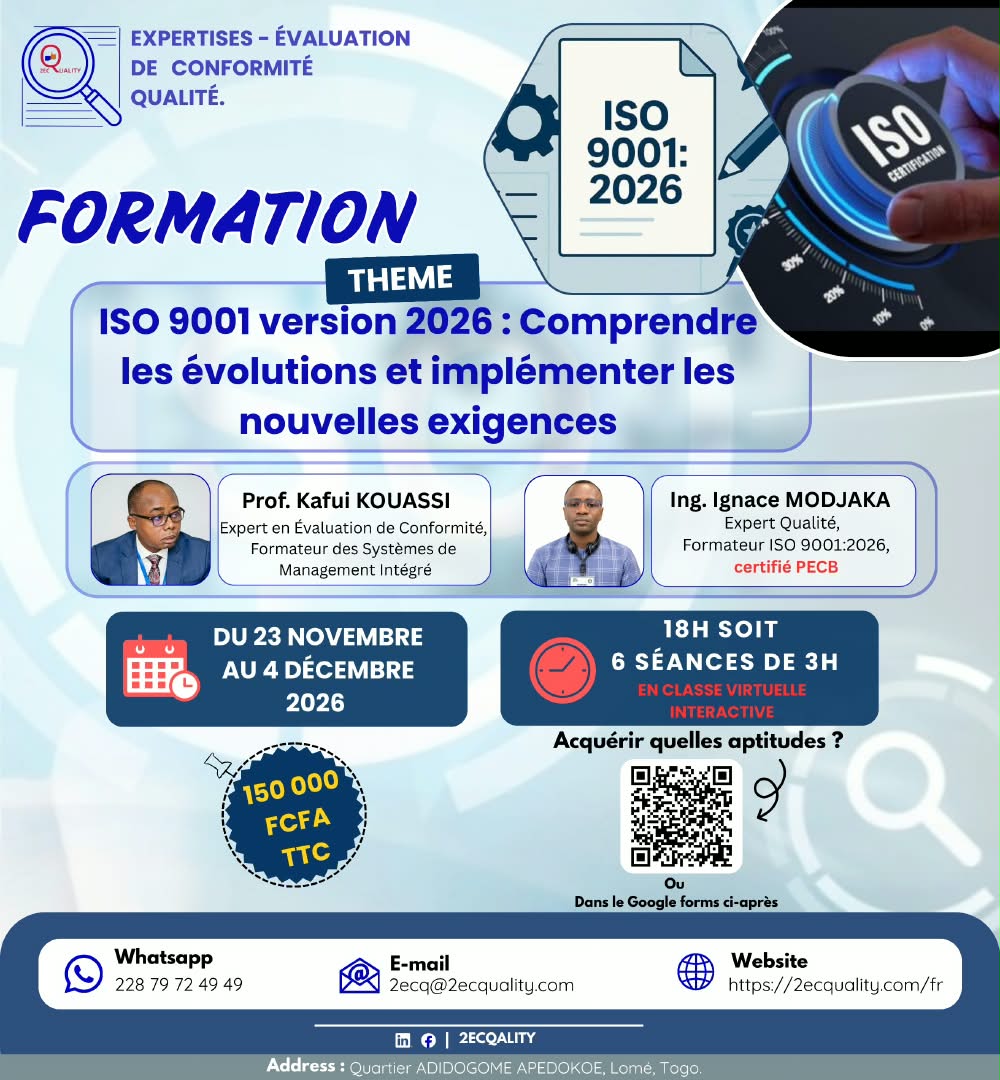
ISO 9001:2026 – Understanding the changes and implementing the new requirements
23/11/2026 2 days (6 sessions of 3 hours) 150 000

ISO 9001:2026 – Understanding the changes and implementing the new requirements

The release of the new version of the ISO 9001 standard introduces changes and clarifications aimed at enhancing the effectiveness of quality management systems. Organizations and companies committed to a quality-focused approach must therefore understand these changes, identify their impact on their existing management systems, and plan the necessary actions to ensure a controlled transition. Upon completion of the training, you will be able to effectively implement the new requirements. Targeted skills: - Identify the key changes between ISO 9001:2015 and ISO 9001:2026, - Explain the new requirements and clarifications, - Conduct an impact assessment to develop a transition action plan, - Effectively implement improvement and compliance actions for the 2026 version.

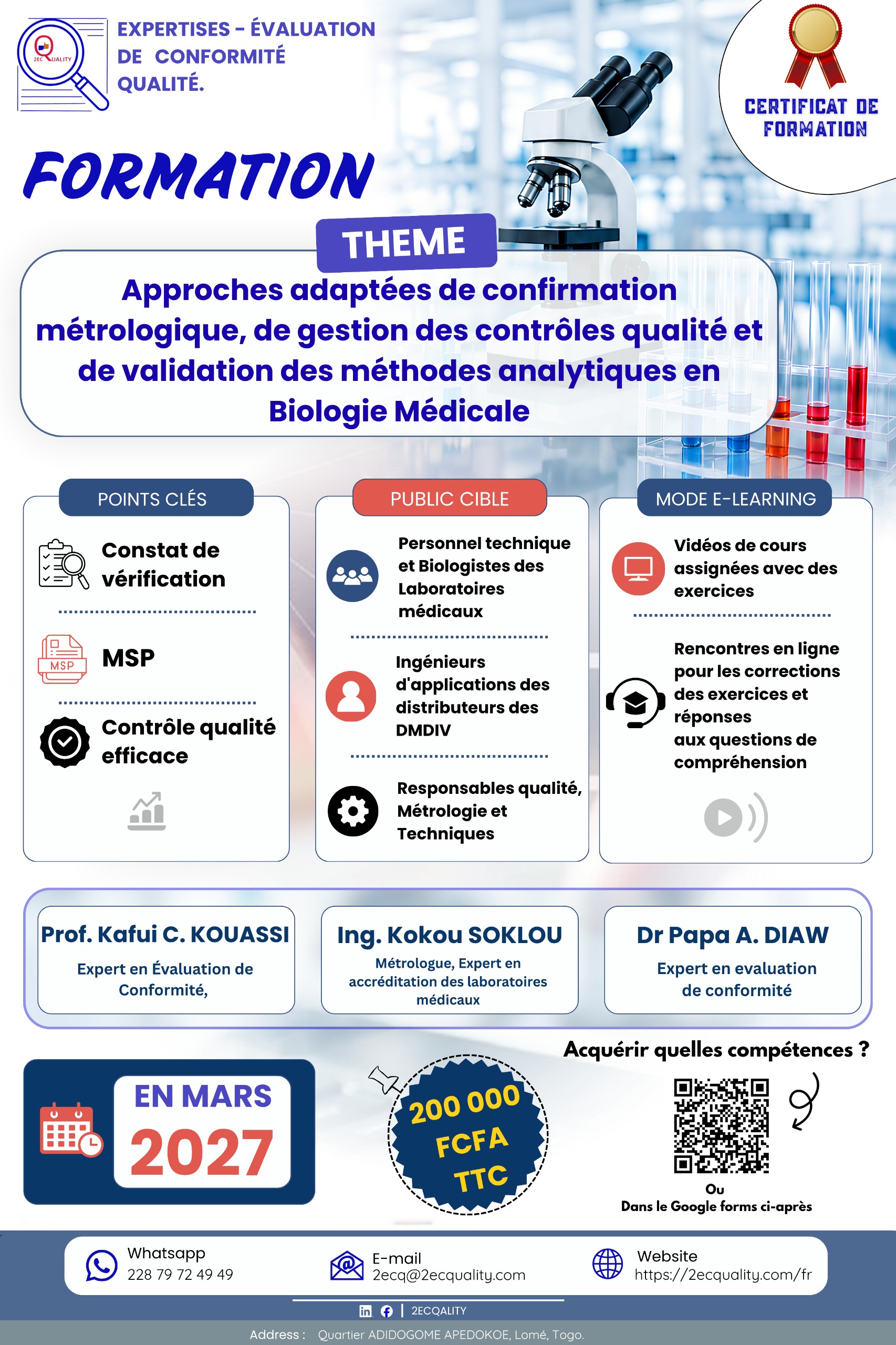
Adapted approaches to metrological confirmation, quality control, and method validation in medical biology
01/03/2027 5 days 200 000

Adapted approaches to metrological confirmation, quality control, and method validation in medical biology

1. Context and Rationale The reliability of medical laboratory results and the successful attainment of accreditation under ISO 15189:2022 depend on the effective management of equipment, quality control, and the performance of examination methods. This training covers tailored approaches to metrological confirmation, the verification and validation of quantitative and qualitative methods, and the estimation of measurement uncertainty in accordance with ISO/TS 20914:2019. It aims to strengthen participants' competencies, enhance the reliability of results, and facilitate the demonstration of compliance with accreditation requirements. 2. General Objective To strengthen participants's competencies in metrological confirmation, quality control, and the verification or validation of quantitative and qualitative methods, in order to ensure the reliability of results. 3. Targeted Competencies Upon completion of this training, participants will be able to: - establish verification findings for measuring instruments, - carry out appropriate metrological confirmation of analytical systems, - apply requirements for controlled and adapted internal and external quality control processes, - perform verification and validation of the performance of quantitative and qualitative methods, - estimate and interpret measurement uncertainty in accordance with ISO/TS 20914:2019, where applicable.

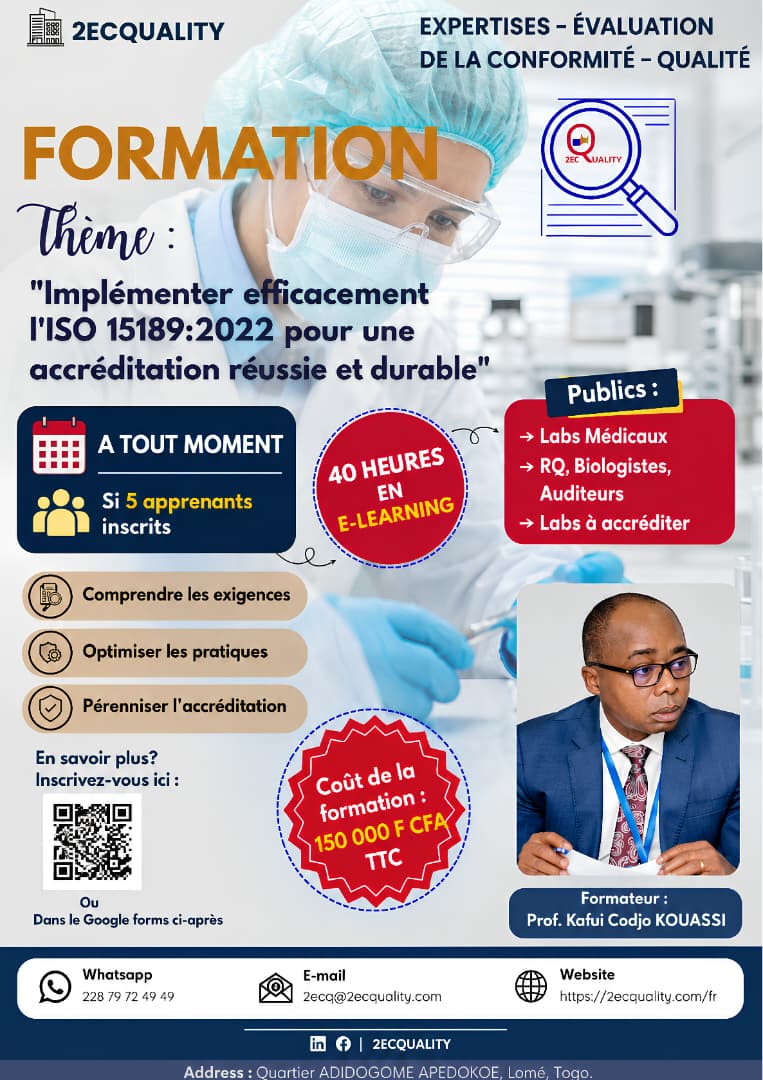
ISO 15189:2022 Training - Effective Implementation for Successful and Sustainable Accreditation
01/10/2026 2 months 150 000 TTC

ISO 15189:2022 Training - Effective Implementation for Successful and Sustainable Accreditation

Enhance your skills in medical laboratory quality management through this intensive 40-hour e-learning course dedicated to the ISO 15189:2022 standard. Videos will be posted online, and slides will be made available to registered participants, allowing them to study at times that fit their professional schedules. Following every four hours of independent study, a two-hour Q&A and assignment review session will be scheduled at a time mutually convenient for all participants. Led by Prof. Kafui Codjo KOUASSI, this course provides practical guidance on understanding the standard's requirements, improving laboratory practices, and implementing an effective quality management system to achieve and maintain accreditation. Training Objectives: - Understand the requirements of ISO 15189:2022; - Implement an effective Quality Management System (QMS); - Optimize laboratory processes and practices; - Prepare successfully for accreditation assessments; - Ensure long-term compliance and continuous improvement. Target Audience: - Quality Managers; - Medical Biologists; - Quality Auditors; - Laboratory Managers and Staff; - Laboratories seeking accreditation.

Can't find what you're looking for?

Contact us to discuss your specific training needs. We also design custom programs.

Contact Us